Your heartbeat is the inheritance of life, continuing the prayers of eight million gods. Without fear, set your true core upright, and simply hold your own light. Then the blue heavens will open, and the rock will open.
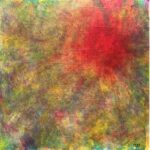
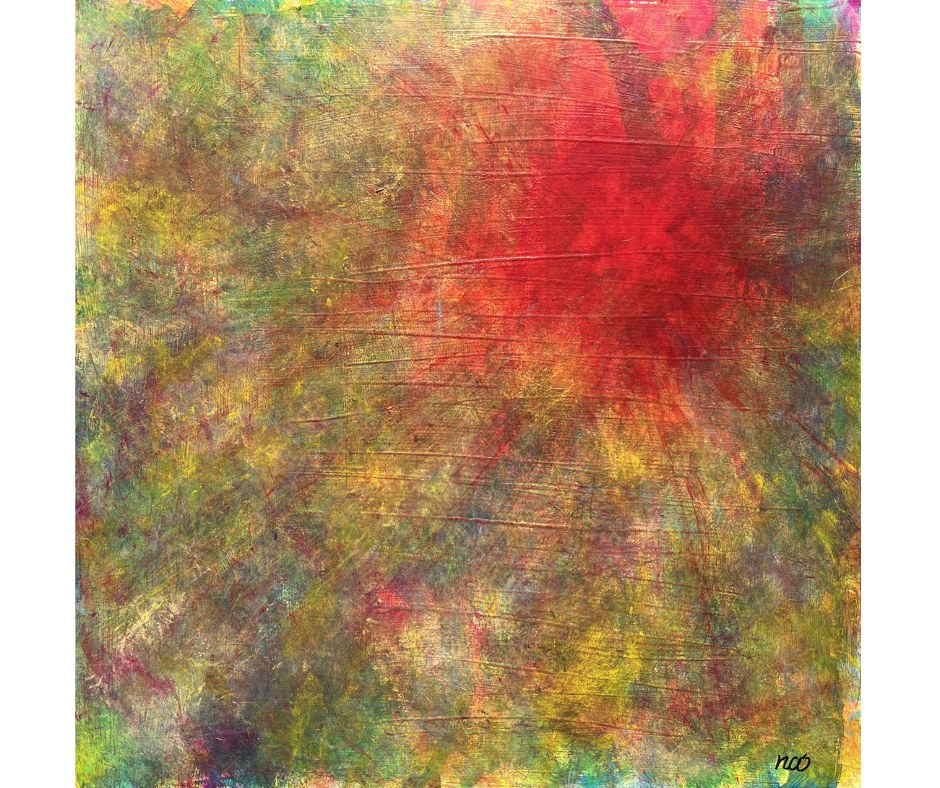
A painting inspired by the Japanese myth of Ama-no-Iwato, the Heavenly Rock Cave. The sun goddess hides in the rock cave, and the world is wrapped in darkness. But the light had not disappeared; it had only hidden itself. I saw this myth not as a story of "loss" but as "a story of light that appears again," and painted it.
The Feeling in This Work
A work for those who take on their own life and are resolved to face forward. For those who move ahead holding their own heartbeat just as it is, without being swayed by the noise of the outside world. You are the very radiance of sunlight. I painted it to tell you that the very fact that you exist is a light illuminating the next era.
Concept & Background
Japan has the idea of yaoyorozu, the eight million gods: that gods dwell in the land, water, wind and soil. A worldview in which the sacred is not far away but dwells in life itself. What this work depicts is not a particular god, but "the light that has been handed down" itself. The place where the hidden sun rises again is not in the sky but within people. And now, that light is about to shine strongly into this era once more.
Technique, Color & Expression
The red spreading across the center of the canvas recalls the rising-sun circle of Japan's flag, while symbolizing the heartbeat of life, the sun within. The light radiating from the center is not a quiet light but one charged with energy strong enough to push open an era. The layers of green and gold around it show the cycles of earth and plants, water and wind, expressing that the light is not isolated but connected to this land. The process of layering, scraping and rubbing again and again signifies the accumulation of time and the recovery of memory.
On Making This Work
We are not isolated beings; we stand within a chain of land, ancestors, myths and prayers. Light does not disappear. It only hides. But now that light is about to shine in strongly again. When you set your true core upright without fear and feel your own heartbeat, the rock cave opens from within.
The sun does not rise in the sky; it rises within you. This work was born to show, powerfully, that your life is always resonating with the light of its time.
This work is not for sale; it is a painting I keep close and treasure. With Personal Order Art, I paint a one-of-a-kind work just for you through a conversation with each person.About using the artwork
More about this painting
The myth of Ama-no-Iwato
The story of Ama-no-Iwato, the Heavenly Rock Cave, is a Japanese myth recorded in the Kojiki, compiled in 712, and the Nihon Shoki of 720.
Grieved by the violent behavior of her brother Susanoo, the sun goddess Amaterasu hid herself in a cave called Ama-no-Iwayato and closed it with a great rock. Heaven and earth fell into darkness, and many misfortunes followed.
The eight million gods gathered at Ama-no-Yasukawara to decide what to do. They made the long-crying birds sing, hung a mirror and jewels on a branch of sakaki, and when the goddess Ame-no-Uzume danced before the cave, all the gods burst into laughter.
Curious about the joy outside, Amaterasu opened the rock door a little. The mighty god Ame-no-Tajikarao took her hand and led her out, and light returned to the world.
The light had not disappeared
What I love about this myth is that the sun did not vanish — it was only hidden.
And the light was not brought back by a single hero. One god made a plan, one made the birds sing, one made the mirror, one danced, many laughed, and one opened the door. Because so many gods each played their part, the cave opened.
The layers of green and gold around the center of this painting express that chain of connection.
Takachiho, where the legend lives on
In Takachiho, Miyazaki Prefecture, Amano-Iwato Shrine enshrines the cave where Amaterasu is said to have hidden. A nearby cavern is said to be Ama-no-Yasukawara, where the gods gathered, and visitors stack small stones there as they make a wish.
In Takachiho, night kagura dances based on the myths are still handed down by local people. A story told for more than a thousand years is still alive in everyday life.
The color red and Japan's sun
The red at the center of this painting recalls the Hinomaru. The flag of a red circle on white was officially made Japan's national flag by law in 1999.
In Japan, vermilion has long been used for the torii gates and halls of shrines, and it is said to be a color of life force and protection against misfortune. The color of the sun, of blood, of life — the red of this painting carries those layers too.
When your rock door opens
Everyone has times when they cannot see the light. But as the myth of Ama-no-Iwato tells us, the light may not be gone — only hidden for a while.
I would be happy if, standing before this painting, you remember the sun within you.
Sources
Kojiki and Nihon Shoki (the Ama-no-Iwato episode)
Takachiho Tourism Association (Amano-Iwato Shrine, Ama-no-Yasukawara)
e-Gov Japanese law database (Act on National Flag and Anthem)