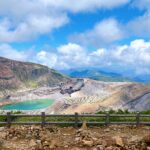
In Yamagata there is a place called Yamadera, "the mountain temple." Its formal name is Risshakuji.
It is known as the place where Matsuo Basho stopped during the journey of The Narrow Road to the Deep North and left a famous haiku.
The cicadas Basho heard
Basho visited Yamadera on the 27th day of the fifth month of Genroku 2 (1689) in the old calendar, which corresponds to mid-July in today's calendar.
There he composed the haiku "Shizukasa ya / iwa ni shimiiru / semi no koe" ("Stillness: the voice of the cicadas seeps into the rocks"). It describes a scene surrounded by rocky mountains, where only the cicadas' voices echo, and they seem to sink into the rock.
Which kind of cicada it was has long been debated. In 1926, a theory that it was the large brown cicada was published, but later studies of the ecology of the Yamadera area found that the large brown cicada had not yet emerged at the time Basho visited, and it is now thought to have been the Kaempfer cicada (niiniizemi).
The temple called Risshakuji
Risshakuji is a Tendai Buddhist temple founded in Jogan 2 (860) by Ennin (Jikaku Daishi) at the request of Emperor Seiwa.
Stone steps continue up the mountainside, and as you climb, the view opens up. The more than 1,000 stone steps are not mere passage; the act of climbing them is itself meaningful.
Not erasing sound, but gathering on one sound
What Basho's haiku conveys is not a place without sound. It is the state of being right in the middle of cicadas singing.
Your mind is clearer when your attention gathers on one thing than when you are exposed to many sounds and much information.Perhaps that is what Basho felt through the rocks and the cicadas' voices.
Time spent standing before a painting has a similar effect. When your view gathers on one painting, the things that were running in parallel in your head stop for a while.
Mermaid nao's personal commissioned art turns what I hear in conversation into color, form and light in a single painting, delivered framed.
Sources
Wikipedia (Shizukasa ya iwa ni shimiiru semi no koe / Risshakuji)
Shiki no Bi (The Narrow Road to the Deep North, "Risshakuji": original text, modern translation and commentary)
Mie no Bunka (The Narrow Road to the Deep North: Risshakuji)
Related articles