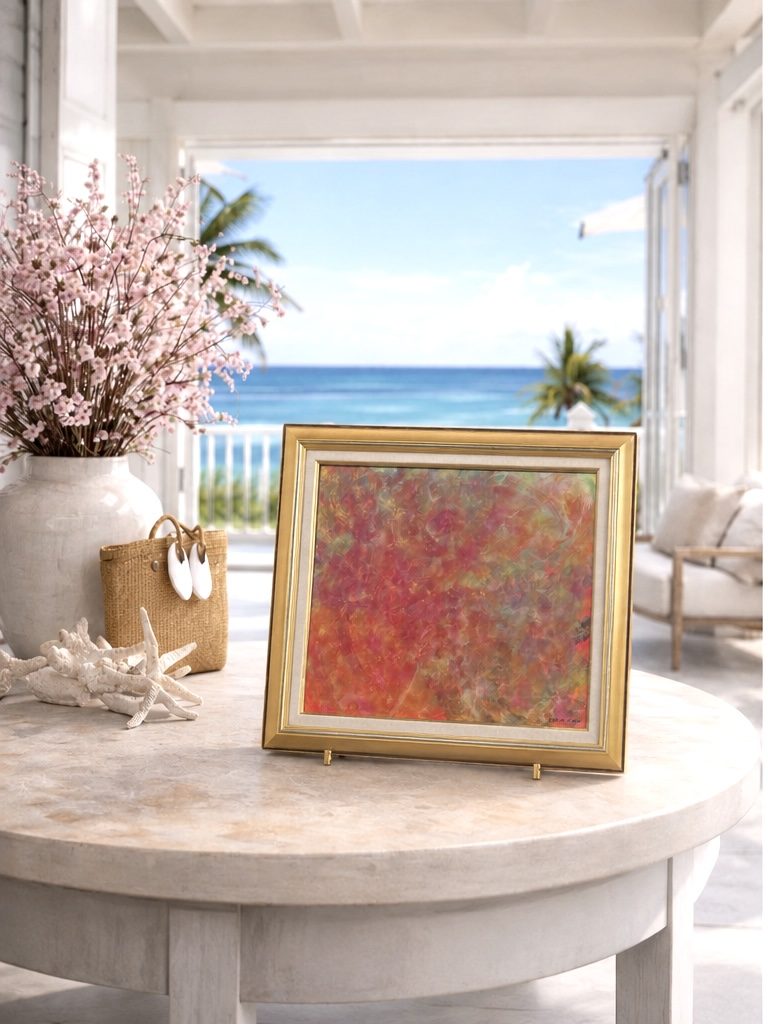
“I would like to hang an abstract painting, but I don’t understand what it means.”
Many people feel this way.
Yet an abstract painting is not a painting without meaning, but one that leaves room for the viewer’s own interpretation. That is why it is hard to tire of, even when you see it every day, and why it looks different depending on who you are that day.
It is natural to find abstract art difficult
A figurative painting shows something: flowers, a landscape, a person. It tells you from the start what to look at.
An abstract painting does not. Only color, form and line are placed there.
The viewer has to build an image on their own, without clues. Feeling that it is difficult is a sign that your mind has started that work.
A study from Tokushima Bunri University considers, from a psychological point of view, that viewing a painting has the power to evoke images in the viewer. Abstract painting can be said to use that power especially strongly.
Abstract painting hands imagination to the viewer
Looking at the same abstract painting, one person thinks of the sea, another of morning light, another of someone seen from behind.
None of them is wrong. The artist placed color and form; what you take from them is left to you.
What this means for a painting you live with: it reflects who you are each time you look at it. On a tired day and on a day of decisions, the same painting looks different.

Research: abstract art shifts how we see things, from near to far
A research team at Columbia University ran three experiments, based on construal level theory, comparing how people respond to abstract versus figurative art. About 840 people took part in total.
The results showed that abstract art tends to be perceived as more psychologically distant than figurative art. The study was published in 2020 in the Proceedings of the National Academy of Sciences (PNAS).
When psychological distance is greater, people tend to grasp things as concepts rather than details. They move toward a mode of thinking about the overall direction, rather than the next task in front of them.
The team notes that viewing abstract art, apart from being enjoyable, can act on a person’s state of mind itself, and may influence how they see things and make decisions.
One set of experiments does not settle everything. Still, it offers a clue: abstract art suits rooms where you want to pause and think about what lies ahead.
Figurative or abstract: which suits you?
If you have a story to share with guests, or a place you treasure, figurative art suits you. It quickly gives you and your visitors something to talk about.
If you want to settle the atmosphere of a space, and leave room for your feelings to move each time you look, abstract art suits you.
Bedrooms, or rooms where you spend long hours alone, are said to go well with abstract art. A painting that asks for no explanation does not disturb your time of rest.
Tips for hanging abstract art
Color. If a color in the painting echoes one already in the room, such as the floor, furniture or curtains, the painting will not look out of place.
Placement. Abstract art comes alive on a wall that enters your view as you walk past, more than on a wall you face head-on, because it looks different from each angle.
Light. Where natural light comes in at a slant, the painting’s expression changes through the day. Avoid strong direct sunlight, which damages colors.
About abstract commissions with Mermaid nao
As part of Personal Order Art, Mermaid nao also accepts commissions for abstract works.
What I receive while listening to you, such as what you hold dear, where you want to head, the light or places you love, becomes one painting made only of color, form and light, without concrete motifs.
Each work is delivered framed. The process and prices are on the order page.
Sources
PNAS (An objective evaluation of the beholder's response to abstract and figurative art based on construal level theory)
Big Think (Viewing abstract art causes notable cognitive changes)
Inverse (One type of art can help you see the bigger picture in life – study)
J-STAGE / Tokushima Bunri University (A psychological study of the image-evoking power of viewing paintings)
Related reading