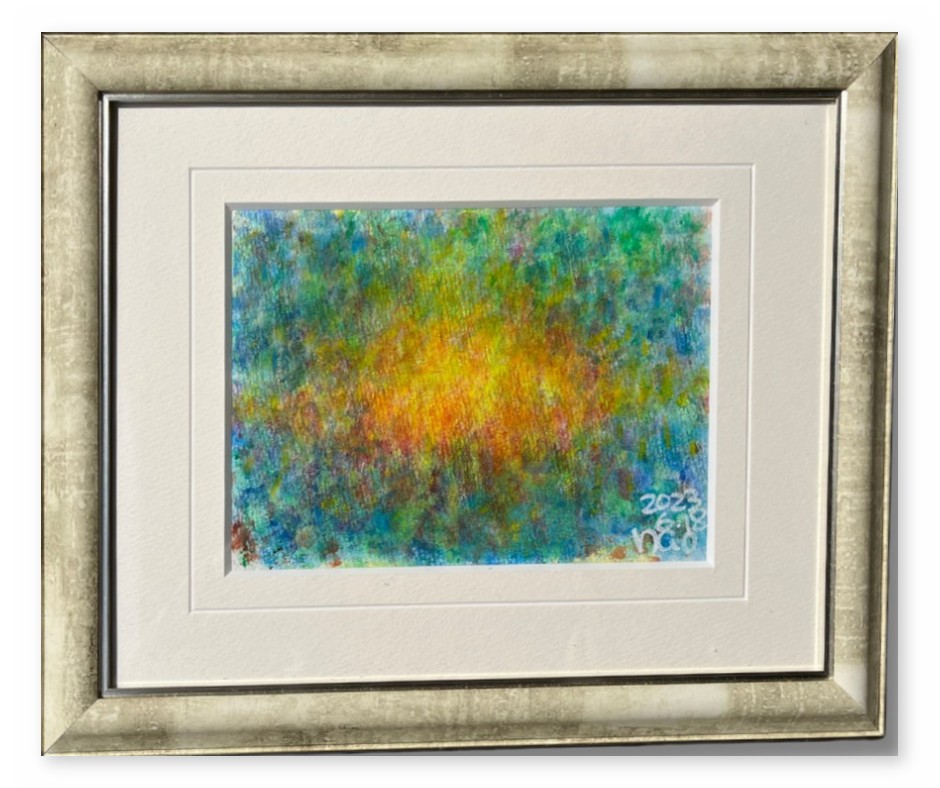
When you look at a painting and feel that it is beautiful, an area just behind the eyes called the orbitofrontal cortex becomes active. That is what research in neuroaesthetics, which studies beauty through the workings of the brain, reports. And in front of a painting that moves you deeply, a brain network that works when you think about yourself also comes into play. Here are three studies.
The same part of the brain responds to paintings we find beautiful
In 2004, Hideaki Kawabata and Semir Zeki of University College London (UCL) published a study in the Journal of Neurophysiology in which they examined the brain with functional MRI while people looked at paintings.
Participants first looked at many paintings and sorted them into "beautiful," "neutral" and "ugly." Then they viewed the same paintings while their brain activity was measured. The study reports that whether the painting was a portrait, a landscape, a still life or an abstract composition, activity in the orbitofrontal cortex differed for the paintings they found beautiful.
What struck me was that abstract paintings were included. Even with a painting where you cannot tell what is depicted, if you find it beautiful, the brain responds in the same way. Kawabata now continues his research on art appreciation and the mind at Keio University in Japan.
The beauty of music and the beauty of painting, in the same place
In 2011, Tomohiro Ishizu and Zeki, also at UCL, carried out an experiment in which 21 participants looked at paintings and listened to music (published in PLoS ONE).
They found that the same part of the medial orbitofrontal cortex (mOFC) was active both when people experienced beauty in paintings and when they experienced beauty in music. And the activity grew stronger in proportion to how intensely they felt the beauty. The team suggests that there may be a single faculty for sensing beauty in the brain, regardless of whether it comes in through the eyes or the ears. Ishizu now continues research in neuroaesthetics at Kansai University in Japan.
In front of a painting that moves us, the brain thinks about "ourselves"
In 2012, Edward Vessel and colleagues at New York University examined how brain activity changes with how strongly people are moved by a painting (published in Frontiers in Human Neuroscience).
As ratings rose, activity in areas that process what we see grew stronger step by step. But a network in the frontal regions became clearly active only for the artworks people found most moving. It included areas of the "default mode network," which works when we think about ourselves.
The team concludes that intense aesthetic experience integrates what we see and how we feel with what it means personally to us. That may be why, looking at the same painting, some people are moved and others are not.
A painting that means something to you
Reading these three studies, I felt a little relieved. Even with an abstract painting where you cannot tell what is depicted, the brain responds if you find it beautiful. And the painting that moves you most is connected to your own story.
As a Japanese artist, I paint commissioned abstract paintings that turn what a person has cherished into color and form, after listening to their story. What the research shows is not a promise that paintings will "work" on people. Still, I believe a painting made for you can reach your heart in a different place from other paintings. The process for ordering is on the PERSONAL ORDER ART page.
Summary
- When we find a painting beautiful, activity in the orbitofrontal cortex changes, regardless of the type of painting, including abstract ones (2004)
- The beauty of paintings and the beauty of music were felt in the same part of the medial orbitofrontal cortex (2011)
- With the artworks that moved people most, a brain network for thinking about oneself also became active (2012)
Sources
Kawabata H, Zeki S. Neural correlates of beauty. Journal of Neurophysiology, 2004
Ishizu T, Zeki S. Toward a brain-based theory of beauty. PLoS ONE, 2011
Vessel EA, Starr GG, Rubin N. The brain on art: intense aesthetic experience activates the default mode network. Frontiers in Human Neuroscience, 2012