The myths of the world have praised the power to live, without denying it.
Desire, obstacles, the setting sun. Affirming all of it and giving it the form of a god is something many cultures share.
Ganesha ― the remover of obstacles
Ganesha is a Hindu god, with the head of an elephant plus a stout body.
Ganesha is regarded as a symbol of the power to remove every obstacle. He is also worshipped as a god of learning plus commerce.
What blocks the way is treated not as misfortune to avoid, but as a realm in which a god takes part. Perhaps here is a way of seeing that accepts difficulty as part of life.
The Barong of Bali ― neither good nor evil wins
The Barong is a sacred beast of Bali. Resembling a lion, it is regarded as a symbol of good that wards off disaster. Its counterpart is the witch Rangda.
The Barong and Rangda are said to wage an endless battle. Whichever falls is always reborn and begins to fight again.
The people of Bali believe the world rests on a balance of good plus evil. In the traditional Barong dance too, the two fight fiercely, but neither ever wins completely.
This story seems to value not eliminating one side, but keeping the balance with both still present.
Ra of ancient Egypt ― sinking, yet always rising
Ra is the sun god of ancient Egypt, regarded as the creator of the universe and the source of all life.
Ra is the sun itself, rising in the east each morning and sinking in the west each evening. He is told of as an immortal being who repeats death plus rebirth within a single day.
Growing dark is not the end. Sinking plus rising are depicted as one continuous circle.
Aizen Myoo ― turning love plus desire into enlightenment
Aizen Myoo is a wisdom king of Esoteric Buddhism. His Sanskrit name is Rāga-rāja: rāga means red, passion plus love, and rāja means king.
With six arms, his whole body is red; he wears a lion crown and sits on a red lotus seat with a sun disc behind him.
Aizen Myoo embodies the teaching bonno soku bodai, that worldly passions are themselves enlightenment. Precisely because there is love plus desire, people wish to go beyond them. It is the idea of turning desire, so often treated as something to erase, into the power to move forward.
Praising the whole of the power to live
What the four gods share is that they face difficult energies head-on, rather than keeping them at a distance.
Obstacles, conflict, darkness, desire. All are things we are sure to meet as long as we live.
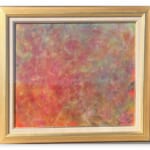
What Mermaid nao tries to paint is not only polished beauty either. It is the very force of life within you.
Not a painting that simply lets you rest, but a painting that keeps the power to move forward beside you. It faces the same direction as what the world’s myths have praised. Each piece is delivered framed.
[References]
Wikipedia (Japanese): Ganesha / Barong (sacred beast) / Aizen Myoo
Egyptian Mythology: List of Gods (Japanese): Ra
waqwaq (Japanese): Ra, the sun god of Egyptian myth who journeys through the day
Eguchi Holdings (Japanese): Balinese legend: the sacred beast Barong plus the witch Rangda
Kotobank (Japanese): What is Aizen Myoo? Meaning plus usage
Related articles