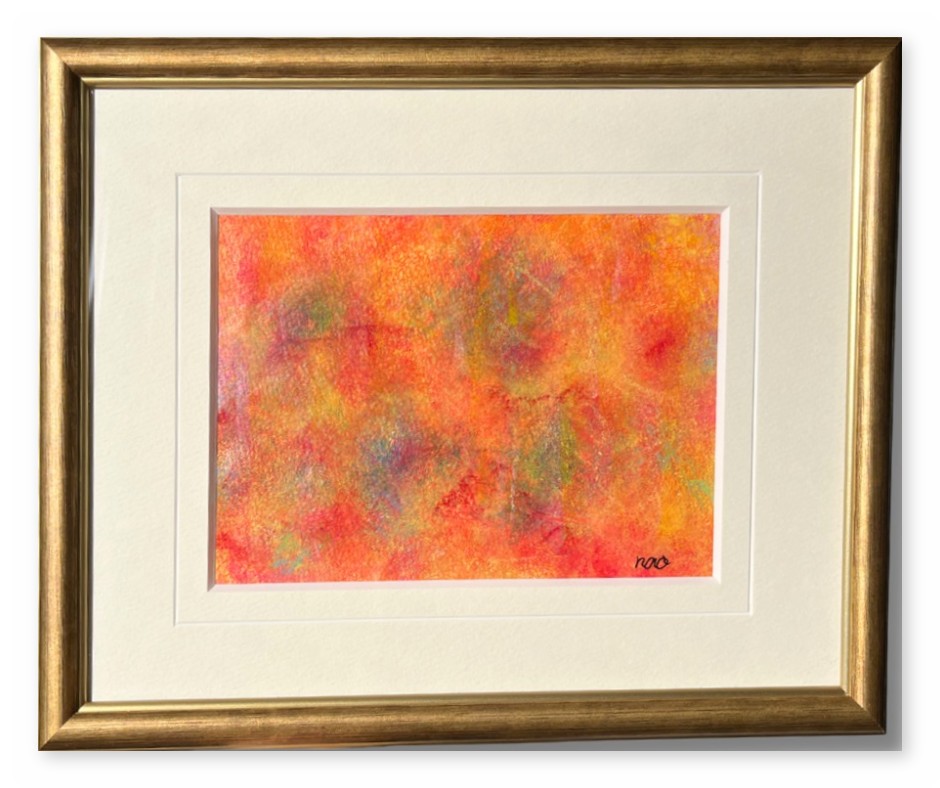
The same painting can say something different depending on where it hangs. I thought about this again after reading a story in the American art magazine ARTnews in October 2026. Here are two painters: one who dreamed of hanging his work in a church, and one who took his paintings back from a restaurant.
Friedel Dzubas, who dreamed of a chapel
Friedel Dzubas (1915–1994) was an abstract painter born in Berlin who moved to the United States in 1939. He knew Jackson Pollock, shared a studio with Helen Frankenthaler, and became known for large, brightly colored abstract paintings.
For a short time in the early 1960s, however, Dzubas set color aside and made paintings in black and white. This followed a trip back to Germany after twenty years, during which he visited Baroque churches and a monastery. He dreamed of covering the walls of a chapel somewhere in Europe with these black paintings. When they were shown in 1962, they found almost no buyers.
Dzubas died without realizing that dream. But in October 2026, Nathalie Karg Gallery in New York opened “Darkness into Light,” an exhibition of these black paintings. The building was once a school belonging to the neighboring Ukrainian church, and the gallery says Dzubas would surely have been happy. Many of the works in the show have found buyers.
Dzubas was also twice a Guggenheim Fellow, in 1966 and 1968. That ARTnews, founded in 1902 and one of the oldest art magazines in the world, is writing about these black paintings today says something about their power.
Nathalie Karg Gallery has built a program of focused historical exhibitions that bring overlooked bodies of work back into view, such as Lebanese-born painter Huguette Caland’s “Silent Letters” (2016) and Al Held’s Paris years. This time, working with Jules Lazare, the gallery has brought Dzubas’s rarely seen black paintings back before the public. In its own way, the show fulfills the dream the painter had more than sixty years ago: to see these works beside a place of prayer.
While he was alive, Dzubas also lent three paintings to a church in Massachusetts, where they hung in the chapel for about a year. Later, when a cathedral in Boston displayed reproductions of his paintings, the cathedral explained that Dzubas had wished his paintings might hang in places of worship.
Mark Rothko, who took his paintings back from a restaurant
The abstract painter Mark Rothko (1903–1970) was commissioned to make a large series of paintings for the Four Seasons, an elegant restaurant in New York. But Rothko decided that a restaurant was not the right place for the work. He returned his fee and withdrew from the commission. In a letter to a friend, he wrote that the two were not for each other.
In 1969, nine of those paintings were given to the Tate in London. The Tate still displays them following the hanging height, lighting and wall color that Rothko recommended. For the artist, where and how a painting hangs was part of the painting itself.
At Tate Modern in London, the Rothko Room, which brings the nine murals together, has become what museum staff call “the must see room,” one of the most loved spaces in the collection. Tate Modern’s collection displays are free to visit (displays change over time, so please check the official website).
Fourteen paintings made for a place of reflection
Rothko went on to paint the works for the Rothko Chapel in Houston. They were commissioned in 1964 by John and Dominique de Menil, a couple devoted to art. After more than two years of work, Rothko completed the suite of fourteen paintings in 1967. He died in 1970, and the chapel opened in 1971.
Today, about 100,000 people of all faiths visit from around the world each year. The paintings and the building have become one: a quiet place to face oneself.
In the reflecting pool in front of the chapel stands Barnett Newman’s sculpture “Broken Obelisk,” dedicated to the Reverend Dr. Martin Luther King, Jr. Since 1986, the chapel has presented the Óscar Romero Award, honoring grassroots activists who work for human rights under extraordinary circumstances. It is a place for looking at paintings, and also a place that has long honored the dignity of every person.
A painting for a company or a clinic
Reading about Dzubas and Rothko, I feel that a painting only becomes complete in the place where it hangs.
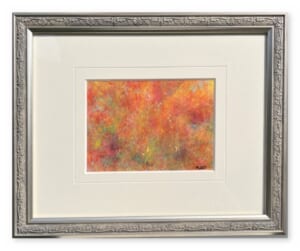
A painting at a company entrance greets the staff who pass it every morning and the guests who visit for the first time. A painting in the president’s office sits beside the person making important decisions. A painting in a clinic waiting room meets the eyes of people sitting there with worries. The same painting takes on a different role depending on where it is placed.
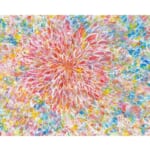
In my BUSINESS ART, I listen to what a company or clinic has cherished and turn it into an abstract painting. Where will it hang, and who will pass in front of it every day? Thinking about that together is, for me, an important part of making the painting. You can read more on the pages for executive offices, reception rooms and workplaces and clinic and hospital waiting rooms, and see the whole picture on the BUSINESS ART page.
Summary
- Dzubas dreamed of filling a chapel with his black-and-white paintings; in 2026 they were shown in a former church school
- Rothko turned down a restaurant commission, and nine of the paintings were given to the Tate
- The fourteen paintings of the Rothko Chapel have welcomed about 100,000 visitors a year since 1971
- A painting for a company or clinic also changes its role depending on where it is placed
Sources
ARTnews (Friedel Dzubas’s Rare Black Paintings Return to New York) (October 2026)
Episcopal Diocese of Massachusetts (Cathedral to mark one year in renovated space with art and thanksgiving) 2016
Tate (Rothko’s Seagram Murals come to Tate St Ives for the first time this summer)
Rothko Chapel (About)
Rothko Chapel (The Óscar Romero Award)
Tate (Making Traces: Behind the Scenes) 2015
Nathalie Karg Gallery (A Black Series: Friedel Dzubas, exhibition announcement on ARTRABBIT)
Lincoln Glenn (Friedel Dzubas)
EBSCO (ARTnews Magazine Archive)
Related reading
- Was The Starry Night a Real Dawn Sky? Van Gogh, Bob Ross, and the Stories Behind Paintings
- What happens in the brain when we find a painting beautiful: three studies in neuroaesthetics
- Japanese abstract painting and the Gutai Art Association
- How to commission an abstract painting: five things to consider first