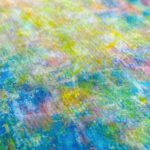
Many people say that tears came to their eyes while looking at the sea, without knowing why. They were not sad, nor especially happy. So why do the tears come? I could not find a study on tears at the sea itself, but psychology has learned a good deal about the tears we shed when we are moved. Here are four studies.
People who live near the coast are more likely to report good health
In 2012, Benedict Wheeler and colleagues at the University of Exeter used census data for England to look at the relationship between how close people live to the sea and their health (published in Health & Place).
They found that good health was more common the closer people lived to the coast. The team suggests this may be because the coast offers more chances to reduce stress and to be physically active. It is one of the studies that shows, in numbers, that the sea gives something to our minds and bodies.
Before something vast, the self grows small
Facing a horizon that seems to go on forever, we can feel very small. Psychologists call the emotion we feel when we meet something far larger than ourselves “awe.”
In 2017, Yang Bai, Dacher Keltner and colleagues at the University of California, Berkeley reported across six studies with a total of 2,137 people that experiences of awe make the sense of self smaller (published in the Journal of Personality and Social Psychology). Other positive emotions did not have this effect. The pattern appeared in both the United States and China, and the smaller the self became, the more people turned their attention to their connection with others.
The “self” that is usually held so tight loosens a little before the vastness of the sea. Perhaps that is when the tears fall.
The tears of being moved
In 2019, Janis Zickfeld and colleagues at the University of Oslo studied the emotion described as being “moved” or “touched” in 19 countries and 15 languages, with 3,542 participants (published in Emotion). Researchers from Toyo University in Japan also took part.
The team calls this emotion “kama muta,” a term taken from Sanskrit. It is a positive emotion that arises when we suddenly feel a stronger connection with people or with what we hold dear, and in every country it came with similar bodily reactions: warmth in the chest, moist eyes or tears, goosebumps, and a lump in the throat.
In 2015, Winfried Menninghaus and colleagues at the Free University of Berlin reported that being moved mixes sadness and joy, and that we can feel it as strongly with books, films and other works as with events in our own lives (published in PLoS ONE). The feeling of crying without being either sad or happy may be close to this mixed emotion.
Tears in front of a painting
Tears do not come only at the sea. In 2015, Matthew Pelowski of the University of Vienna surveyed visitors at museums in the United Kingdom, Japan and the United States, including people looking at abstract paintings (published in Frontiers in Psychology).
In all three countries, people who felt like crying in front of a work were more likely to find it good and beautiful, to grasp its meaning, and to reflect on themselves or reach a new insight. Pelowski suggests that tears may be a sign that something has been rearranged inside the viewer.
A painting made for you
I paint under the name “Mermaid nao.” I feel that the tears that fall before the sea and the tears that fall before a painting are connected somewhere. Both may be a sign that the heart has moved, on touching something larger than ourselves, or something we hold dear.
My order art is abstract painting that turns what a person has cherished into color and form, after listening to their story. The research does not promise that a painting will bring tears. Still, I believe a painting made for you can quietly move your heart, the way the sea sometimes does. You can read about how ordering works on the PERSONAL ORDER ART page.
Summary
- People living closer to the coast were more likely to report good health (2012)
- Experiences of awe make the sense of self smaller and turn attention to our connection with others (2017)
- The emotion of being moved comes with warmth in the chest, tears and goosebumps in 19 countries (2019)
- Museum visitors who felt like crying were more likely to grasp a work’s meaning and reflect on themselves (2015)
Sources
Wheeler BW, White M, Stahl-Timmins W, Depledge MH. Does living by the coast improve health and wellbeing? Health & Place, 2012
Bai Y, Maruskin LA, Chen S, et al. Awe, the diminished self, and collective engagement: Universals and cultural variations in the small self. Journal of Personality and Social Psychology, 2017
Zickfeld JH, Schubert TW, Seibt B, et al. Kama muta: Conceptualizing and measuring the experience often labelled being moved across 19 nations and 15 languages. Emotion, 2019
Menninghaus W, Wagner V, Hanich J, et al. Towards a psychological construct of being moved. PLoS ONE, 2015
Pelowski M. Tears and transformation: feeling like crying as an indicator of insightful or “aesthetic” experience with art. Frontiers in Psychology, 2015