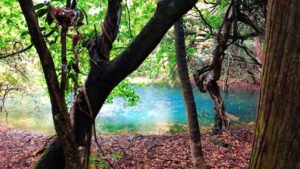
Today I went to Eboshiyama Hachimangu, a shrine in Akayu, Nanyo City. It is known for its cherry blossoms, but the quiet grounds in this season were lovely too.
A sacred garden made by the townspeople
This shrine, along with Eboshiyama Park around it, has a story behind it. In the early Meiji era, Akayu suffered one fire after another plus outbreaks of disease, and the hot spring town lost its liveliness.
Local volunteers then formed an association, joined forces, bought the old tea fields plus mulberry fields, and cleared the land. They planted many cherry trees, created a large sacred garden centered on the shrine, and completed it in 1883 by moving the Hachimangu there and enshrining it.
Today the Eboshiyama Senbonzakura has about 1,000 trees of 25 varieties. There are Somei Yoshino trees 120 years old, along with a cluster of Edohigan cherries that is rare even worldwide, and the site has been chosen as one of Japan's Top 100 Cherry Blossom Spots. It is a landscape grown over 140 years by the hands of people who tried to rebuild their town.
A stone torii without joints
On the grounds stands a large stone torii gate, 10.75 meters tall. It was built in 1903 (Meiji 36) from tuff cut from the hill behind the shrine. The Japan Record Certification Association has certified it as the largest jointless single-stone torii in Japan. A national record, right next to Akayu Onsen.
Jointless does not mean the whole torii was carved out of one rock. It means that each large part, such as the pillars, was made from a single huge stone, without adding pieces partway. In the Meiji era, with little heavy machinery, people cut out stones about ten meters long, carried them, raised them, then put them together. Look closely at the pillars and you can see there really are no joints.
The weeping cherry trees together with this stone torii are worth seeing even outside the blossom season.
From nearby Sosho Park you can look out over the Yonezawa Basin. In early summer, its rose garden opens.
Heading out with an eye on direction
When I go out, I pay a little attention to directions in Kyusei Kigaku, Nine Star Ki. I feel that September holds many good days plus good directions for me (Ichihaku Suisei, One White Water Star), and on this day too I chose a day with a good direction to visit.
Rather than whether it comes true, I use it as one measure for deciding for myself that today I will go here. When I decide and then move, the way I take in that day changes.
Prayer, and making a landscape
What stayed with me most at Eboshiyama was not the cherry trees themselves, but the fact that there were people who tried to rebuild a declining town through prayer plus planting trees.
Painting is somewhat similar. It does not work right away, but if you keep going, the landscape changes little by little. When I paint a piece of order art, it is with the feeling of placing a single seed in the landscape of your days ahead.
Mermaid nao's order art aims to be a piece that helps you move forward.
[References]
Eboshiyama Senbonzakura Preservation Society (Japanese): One of Japan's Top 100 Cherry Blossom Spots
Eboshiyama Hachimangu (Japanese): Eboshiyama Park Senbonzakura
Yamagata Tourism (Japanese): Eboshiyama Park
Nanyo City Tourism Association (Japanese)
Japan Record Certification Association, japaneserecords.org (Japanese): The largest jointless single-stone torii in Japan
Related articles